




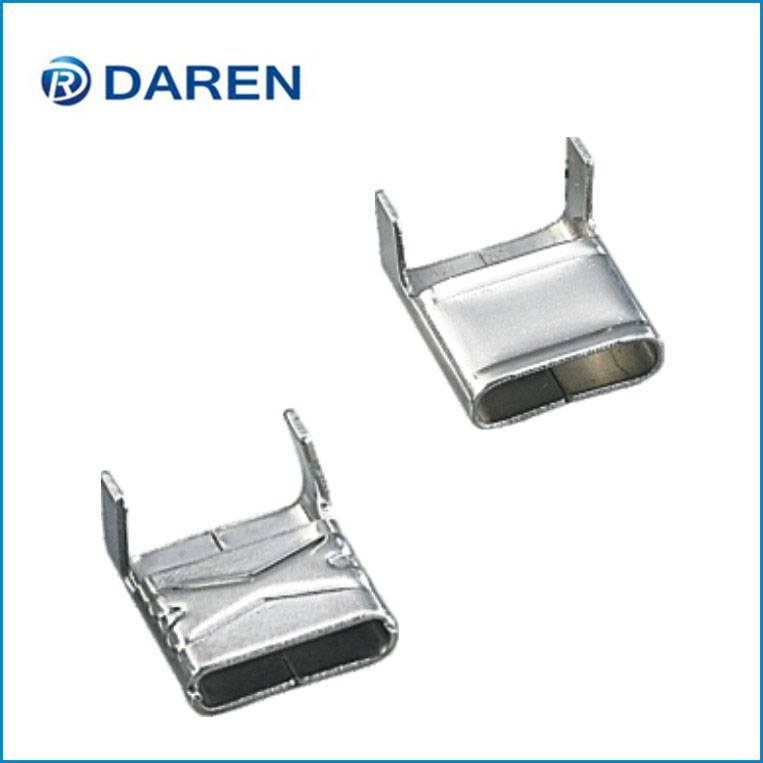
L Type Buckles are common in pole mounting procedures where the utility pole, street light pole or traffic signal pole need to be secured with stainless steel or polymer-coated bands. In addition, for electrical contractors, buckles directly affect reaching a faster installation process, using less effort, and choosing proper equipment.
This article covers the production process of L Type Buckles, while also mentioning the relevant specifications, OEM options and quality control process prior to the delivery.
Raw Material Selection and Coil Preparation
Production starts with stainless steel in the form of coils. Some common grades are SS201, SS304, and SS316. While SS304 is suitable for all outdoor uses, SS316 is more commonly used in marine and industrial environments. SS201 is for indoor use and areas that do not have much corrosion.
The coils are inspected for any inconsistencies in regards to their thickness, surface condition, and width. In case of polyester-coated coils, the coating has to be uniform, with no cracks or peeling. Hence, proper preparation of the coils allows the buckles to work properly with standard banding systems when produced.
Typical specifications include:
- Material: SS201 / SS304 / SS316
- Finish: Plain or polyester coated
- Width: 12 mm, 16 mm, 19 mm, or 20 mm
- Thickness: 0.5 mm, 0.6 mm, 0.7 mm, or 0.8 mm
- Surface: Smooth edges to reduce band and pole damage
Stamping, Bending, and L Shape Forming
The material is processed after coils are prepared. At this point, the material undergoes stamping, cutting, and bending to form an L shape. This design ensures the band remains in place during installation.
The manufacturers concentrate on achieving the same bending angles, smooth edges, no sharp burrs, and steady locking mechanism. An effective buckle makes the process of pole installation easy and reliable, especially when working with a number of them in one project.
Surface Treatment and Coating Options
Plain stainless steel buckles are dependent on the quality grade of stainless steel for corrosion resistance. The polyester-coated variations provide an additional protection ensuring minimum metal-to-metal contact between the buckle, the strap and the pole.
This applies to poles covered in paint, powder coating, or galvanizing. Coating inspection involves testing for adhesion, edge coverage, color consistency, and scratch resistance experienced in handling
OEM Customization Options
Several projects necessitate something else other than standard sizes, which is when OEM options come to the scene. OEM allows buyers to adjust their products to meet the necessary banding systems, pole diameters, or project specifications.
Common OEM options include:
- Custom width and thickness
- Custom bending shape or opening size
- Different stainless steel grades
- Plain or polyester-coated finish
- Custom or branded packaging
- Small-batch or project-based production
Supplying information such as the band width, band thickness, pole diameter range, installation type, and material grade will make the OEM production more accurate.
Quality Control and Inspection Process
The aspects covered in the quality control process are including materials, dimensions, appearance, and function of the product. A standard inspection procedure includes:
- Material verification — Confirm grade, coil thickness, and coating type.
- Dimensional check — Measure width, thickness, bending angle, and opening size.
- Visual inspection — Check for burrs, sharp edges, coating defects, or deformation.
- Fit check — Test compatibility with the matching band and tensioning tool.
- Function check — Confirm smooth band feeding and proper tension holding after locking.
- Batch traceability — Record material batch, production batch, size, grade, and quantity.
With this technique, problems occurring frequently during installation, including slippage of the bands, poor locking of the bands, and damage to the surfaces, can be handled successfully.
Packing, Delivery, and Project Support
After the inspection process, buckles are packed in accordance with order specifications. The available options for packing include standard boxes, bulk packaging, small packs of buckles, using pallets for big bundles, or having custom labels with size, grade, and number of buckles.
Contractors often prioritize having a correct buckle and band as well as a tool within one compatible system rather than choosing one specific item.
Frequently Asked Questions
1. What is an L Type Buckle mainly used for?It is utilized with the help of stainless steel or polyester-coated bands, made for pole mounting in electrical, telecommunications, traffic, lighting, and outdoor infrastructure projects.
2. Which stainless steel grade should I choose?In terms of stainless steel types, SS304 is recommended for general outdoor applications, SS316 is suitable for coastal and chemical surroundings and SS201 is appropriate for lower-grade indoor applications.
3. Can the buckle be used on painted or galvanized poles?Indeed. Buckles made from coated polyester can provide the benefits of less metal contact and reduced risk of scratching on the exposed surfaces.
4. What information is needed for OEM orders?Bandwidth, thickness of band, grade of metal, type of finish, number of items, shape of the bend, any request for specific packaging or labels.
5. How do you check buckle quality before delivery?Verified through material verification, measurements for dimensions, visual inspection, fit test and functionality tests to ensure locking and tension holding capabilities.
6. Are L Type Buckles compatible with all banding tools?The compatibility is a function of width, thickness, buckle style, and type of tool. Be sure it matches before installing it.
7. Can you supply small quantities for trial orders?It is contingent on the manufacturer and product characteristics. A lot of companies may provide a trial or a sample amount of products prior to placing orders for bulk projects.
8. How should the buckles be stored before installation?Keep the product in a climate-controlled area, away from heavy weights, moist situations, and pointed items. Be cautious when using coated fasteners so that the coating doesn’t get harmed to guarantee proper functionality.
Post time: Sep-19-2026