




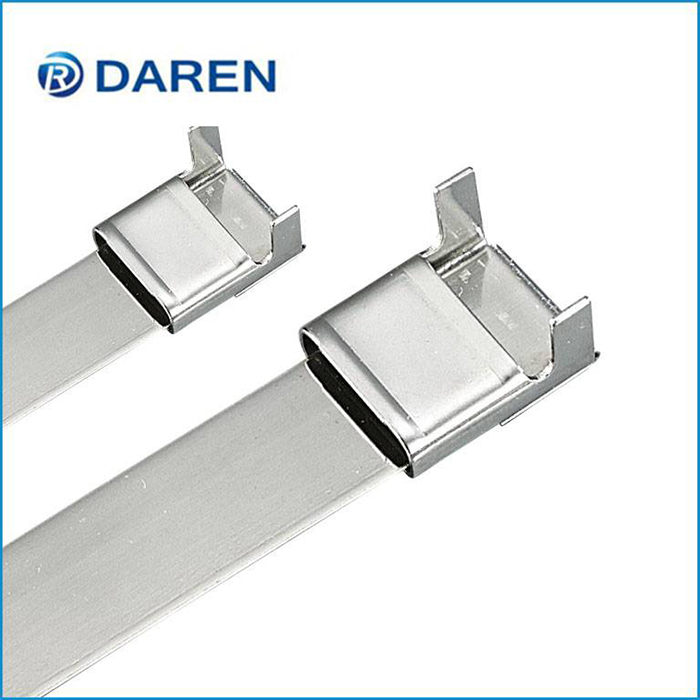
In case nylon ties become hard after exposure to UV, or coated metal ties do not work at high temperatures, installers have to use all-metal fasteners. L type uncoated stainless steel cable ties – a band of stainless steel pre-loaded with a small L-shaped buckle – is ideal for utilization in petrochemical plants, power plants, at sea and in places where heat, erosion, and vibrations occur quite often.
What Makes the L-Lock Design Different
The band and buckle are supplied together. This means that they save about 30% of installation time compared to attaching separate straps and buckles. Stainless steel in austenitic form is used for ties – for example, SS304 and SS316 are used, and SS201 may be chosen as an inexpensive option for mild indoor conditions.
The L-type buckle is a light-duty buckling device. When the buckle is tensioned using a strapping tool, the teeth of the buckle lock themselves in place. In comparison with different types of locks:
- Works well in tight spaces where bulky heads will not fit
- Can be released and reused, unlike one-way ball-lock ties that must be cut off
- For heavy loads, toothed (fang-type) buckles or ball-lock heads are the upgrade path
Why Uncoated? Temperature and Fire Performance
The term “uncoated” refers to what is often termed as bare or white-steel — meaning no PVC, epoxy or powder coating is used, which enables the extreme performance.
- Service range of -80°C to +538°C, far beyond coated variants (typically ~150°C)
- Fireproof: no plastic to burn, no toxic fumes, no sagging cables
- UV resistant: no polymer to degrade in sunlight
- Chemical resistant: suited to refineries, offshore platforms and mining sites
The direct contact between the metal and wire leads to a trade-off. In situations where the jacket’s covering or insulation is of more importance than the temperature resistance requirements, opt for the non-metallic version.
SS304 vs SS316
| SS304 | SS316 / 316L | |
|---|---|---|
| Composition | ~18% Cr, 8% Ni | Adds 2–3% molybdenum |
| Best for | General outdoor/industrial use | Marine, offshore, chemical, coastal sites |
| Cost | Lower | Higher |
Rule of thumb: SS304 is used for usual applications; SS316 in places where there is a possibility of saltwater or chemical exposure as molybdenum makes the product highly resistant to pitting.
Key Specifications
Typical parameters (exact values vary by manufacturer):
| Parameter | Range |
|---|---|
| Width / thickness | 4.6–19 mm / 0.25–0.4 mm |
| Length | 100–1000 mm, custom available |
| Max bundle diameter | 37–206 mm depending on length |
| Loop tensile strength | ~1200 N (270 lbs) at 12 mm; ~1500 N (337 lbs) at 15 mm |
| Packing | 100 pcs/bag (typical) |
Applications
L type uncoated ties are specified wherever plastic fasteners do not survive:
- Petrochemical & oil and gas: instrument cables and pipeline lagging in corrosive atmospheres
- Power & solar: cable tray fixing in hot zones; UV-proof racking and DC cable management
- Marine & offshore: cable routes on ships and platforms (SS316 recommended)
- Telecom, traffic signals, mining, signage: outdoor pole, mast and heavy-duty bundling
Installation in 5 Steps
Uses a universal stainless steel strapping tool (LQA series):
- Measure the wrap and cut the band, leaving at least 10 cm extra for tool gripping.
- Wrap around the bundle or pipe — single wrap for L-lock duty.
- Tension with the tool until snug; avoid over-tightening on soft-jacketed cables.
- Crimp the buckle and shear the excess band in one motion.
- Check the cut tail — fresh stainless edges are sharp; wear cut-resistant gloves.
Choosing a Supplier
- Request a mill test certificate (MTC) — SS201 is sometimes passed off as SS304
- Ask for salt-spray results: 96 h without red rust is baseline; premium products reach 1000 h
- Confirm certifications (ISO 9001, CE, RoHS) and custom-length capability
FAQ
Can these ties be used outdoors?
Yes. Bare stainless steel is UV-proof and weatherproof across the full -80°C to 538°C range.
Are L-lock ties reusable?
The buckle lets you unfasten the strap and reuse it, making it easier to maintain, which you cannot do with the ball-locks that cannot be unlocked.
L type or ball-lock: which should I buy?
Ball-lock provides the greatest permanent tensile strength, while L-lock is ideal for cost-effectiveness, limited spaces, and serviceability.
304 or 316 for coastal projects?
316, for its superior chloride and salt-spray resistance.
Conclusion
L type stainless steel cable ties without coating have an all-metal fireproof construction, a wide range of temperature tolerance, SS304 and SS316 rust proof chất lượng. In cases where plastic ties are ineffective they prove to be one of the most affordable steel fastening alternatives.
Check the type of steel, match the width and tensile class with the load. Be sure to check performance in salt-spray tests before placing the order. Contact our sales department with your size queries in order to receive quotation and samples for on-site testing.
Post time: Sep-23-2026