




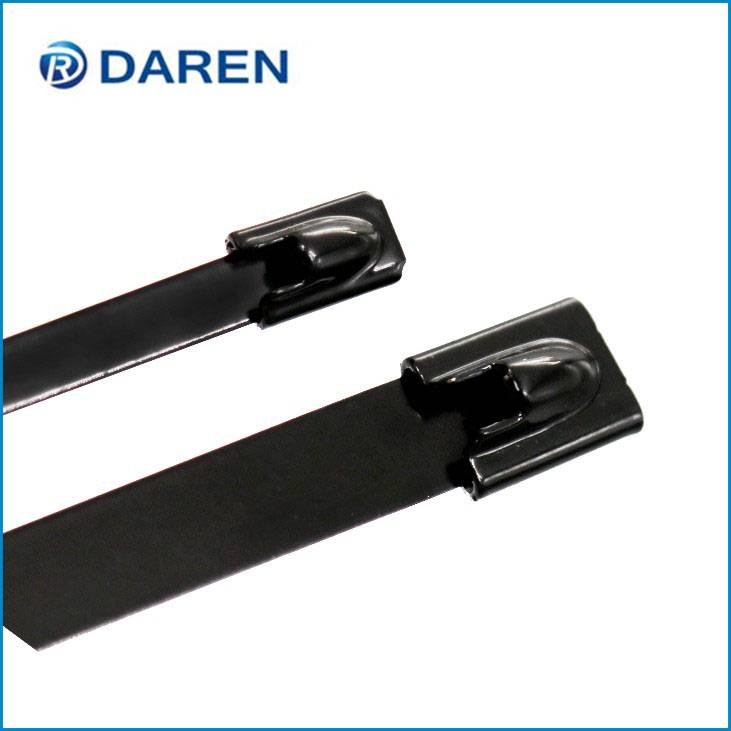
A polyester coated tie is a ball-lock stainless steel strap that has been fully sprayed with a thermoset polyester-epoxy layer before shipment. The steel core gives the holding tension, and the plastic layer changes what the tie can safely touch. This article explains how the coating works, how the three stainless grades differ, and which specifications to check before you place an order.
What “Fully Coated” Actually Means
On a bare stainless steel cable tie, the stamped edges and the ball-lock head are exposed metal. When you pull a bare tie tight around a cable harness, a conduit or a soft pipe, those edges can dig into the outer jacket over time. A polyester coating solves that by covering the strap body, the lock head and the cut end in one continuous film. The product page describes the process as plastic-sprayed epoxy paint applied after forming, with a working range of -40°C to 85°C.
The ball-lock mechanism itself is unchanged: a spring-loaded ball inside the housing lets the strap slide one way and bites it when tension releases. The coating sits over that ball, so the installer still hears the familiar ratchet click but never contacts sharp steel directly.
Why Specifiers Pick Coated Over Bare
Three reasons come up repeatedly in real installations:
- Edge protection. The rounded plastic surface presses against cables and pipes instead of a stamped metal edge. This matters on thin-walled conduit, rubber hoses and low-voltage wire jackets where abrasion shows up as premature jacket failure.
- Galvanic isolation. When a bare stainless strap is clamped directly onto aluminum cladding, copper busbar or dissimilar metal hardware, the contact point can become a corrosion cell. The polyester film keeps the two metals separated electrically, which slows that process in outdoor and coastal exposures.
- Static and finish protection. The sprayed layer is non-conductive, so coated stainless ties are preferred on painted panels, stainless railings and equipment where a bare steel strap would scratch the finish or leave a contact mark.
Choosing the Stainless Grade: 201, 304 or SS316
Polyester coated SS316 cable ties are the grade buyers reach for in marine, coastal and chemical environments, because the molybdenum in 316 resists chloride pitting that 304 cannot. Coated 304 ties are the default for general outdoor and industrial indoor use. Coated 201 ties are the economical option for dry, indoor bundling where corrosion exposure is low.
The coating adds a layer of its own protection, but it is not a substitute for the right alloy. If the coating is nicked during installation, the exposed steel underneath still needs to survive the site environment. Order 316 when chloride, salt spray or washdowns are on the drawing; do not assume the plastic film makes 201 behave like 316.
Key Specifications to Compare
Manufacturers list the same width options across the range, but thickness and pull-out rating change with width. The table below summarizes the ball-lock fully polyester coated ties from the product page.
| Width (mm) | Thickness (mm) | Min. Tensile (N) | Recommended Tool |
|---|---|---|---|
| 4.6 | 0.25 | 1000 | CT02 / HT-338 |
| 7.9 | 0.25 | 1000 | CT02 / HT-338 |
| 10 | 0.25 / 0.30 | 1000 | CT02 |
| 12 | 0.25 / 0.30 | 1000 | CT02 |
| 16 | 0.30 / 0.40 | 1000 | LQB / C002 |
Lengths run from 100 mm upward, and maximum bundle diameter scales with length. For a 4.6 mm-wide strap, a 200 mm tie reaches roughly 50 mm bundle diameter, while a 500 mm tie reaches about 128 mm. Choose length by bundle diameter, not by the number of cables; a tie that is too long leaves a sharp tab sticking out after the tool trims it.
Installation Notes
Installation follows the same four steps as any ball-lock strap: wrap the tie around the bundle, thread the tail through the head, tension with a dedicated stainless tie tool, then trim the excess in the tool’s knife edge. Do not use diagonal cutters on a coated tie — they crush the coating at the cut point and leave a sharp steel burr. The CT02, HT-338, LQB and C002 tools are the matched tension-and-cut combinations listed on the product page.
Inspect the coating after tensioning. If the film cracks at the ball head, the tie was either over-tightened or installed with an improperly calibrated tool. A cracked coating means the isolation benefit is gone, and the strap should be replaced rather than reused.
Bottom Line
Polyester coated ties are worth the premium over bare stainless when you are clamping finished surfaces, dissimilar metals or soft cable jackets. Pick 201 for dry indoor work, 304 for general outdoor service, and SS316 where salt or chemicals are present. Match the width to the bundle load and the length to the bundle diameter, and use the correct tensioning tool to keep the coating intact.
FAQ
Q: Are polyester coated cable ties UV resistant?
A: The polyester‑epoxy coating works outdoors from -40°C to 85°C, but it mainly protects against corrosion and abrasion, not long‑term UV. For strong, continuous sunlight, pick 316 stainless steel and check coating details with the supplier.
Q: Can I reuse a coated stainless tie after cutting?
A: No. Ball‑lock ties are single‑use. They cannot be reopened once locked and trimmed.
Q: How is a coated stainless tie different from a nylon cable tie?
A: Nylon ties weaken under heat and UV. Coated stainless ties have a strong steel core with polyester protection. They support heavier loads and wider temperature ranges, yet need special tensioning tools.
Q: When should I choose coated stainless steel cable ties over bare ones?
A: Use coated ties to avoid scratching cables, hoses, painted surfaces, aluminum or copper parts. Bare stainless ties suit internal hidden applications bundling steel components.
Post time: Nov-07-2026


